Authorization Hub integration
Authorization Hub is Axiomatics' control plane system for authorization domains, policies, attributes, and attribute connectors. It stores policies and configurations that ADS retrieves for policy evaluation. Earlier versions of the control plane were known as Axiomatics Services Manager (ASM) or ADM; these names may still appear in older documentation or API paths but refer to the same system.
By connecting APD to Authorization Hub you can push and pull attribute, attribute connectors and policies between the two components.
In the control plane, an authorization domain is identified by a project (namespace) and a domain name.
To connect to a Authorization Hub, add a hub block within the repositories section in your build.gradle file.
alfa {
 project 'Project 1'
    repositories {
        hub {
            environment 'Dev'
            host 'https://adm.dev.myorg'
            domainName 'domain1'
            envVariable 'LDAP_PIP_URL', 'http://ldap-dev.myorg.com'
            oidcCredentials {
                client_id 'apd'
                client_secret '<secret>'
            }
        }
    }
}
| Property | Description |
|---|---|
environment | A label for this Authorization Hub connection, used only to name the Gradle tasks APD generates (for example, axiomatics-hub-dev) and has no effect on the actual Authorization Hub connection. Choose a name that reflects the target environment, such as dev, qa, or prod. |
host | Protocol and hostname of Authorization Hub. |
realm | The OIDC realm in Authorization Hub. Default is hub. |
domainName | The domain name in Authorization Hub. |
envVariable | Optional property. Sets environment variable if you run this domain with ADS from within Axiomatics Policy DevOps. Multiple envVariables properties are possible. Comma separated key,value. |
client_id | The client ID to use for OIDC authentication to Authorization Hub. |
client_secret | The client secret to use for OIDC authentication to Authorization Hub. |
The Authorization Hub project is set globally in the alfa{} section and will be the same for all repository entries.
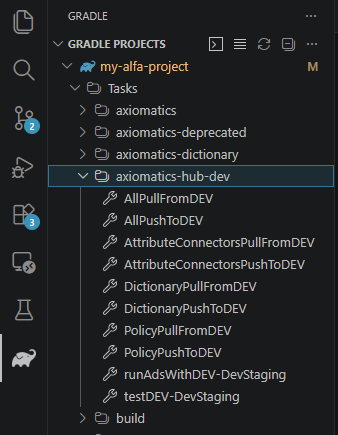
Adding an Authorization Hub repository generates a new Gradle task group axiomatics-hub-<environment>with related tasks. The screenshot below shows the result after adding an hub repository with the environment name "dev" to build.gradle. The task group axiomatics-hub-dev is created, containing two tasks: runAdsWithDev..., and testDev....
Certificates
Any certificates required for TLS communication with Authorization Hub or ADS should be added to the appropriate truststore (for example, the operating system's truststore or Java's truststore). Alternatively, you can specify a custom truststore (JKS or PKCS12 format) using standard Java system properties.
# Restart Gradle deamon (../gradlew --stop) after changing these lines, otherwise changes may not be loaded
systemProp.javax.net.ssl.trustStore=mycacerts.jks
systemProp.javax.net.ssl.trustStorePassword=changeit
systemProp.javax.net.ssl.trustStoreType=JKS
or
./gradlew -Djavax.net.ssl.truststore=mycacerts.jks
...
You should restart the Gradle daemon using ./gradlew --stop to apply any changes.
Tasks
-
runAdsWithDev-DevStagingStarts a local ADS instance with the Authorization Hub domain, using a random, unencrypted local HTTP port and basic authentication (username:
pdp-user, password:secret).noteYou can add environment variables using
envVariable 'KEY', 'VALUE'within thehubblock.runAdsWithDev-DevStaging output* Executing task: gradle: runAdsWithMDP-myDomain> Task :spawnAdsWithMDPmyDomainRepo is type Authorization HubLocation of domain is https://<host>/api/adm/namespaces/4d8885b6-6245-46ff-90ec-6f1f37105ed5/names/myDomain/domain> Task :waitToStartAdsMDPADS successfully started!> Task :runAdsWithMDP-myDomainADS is running on port 58387. To see ADS output run gradle with --info. Stop it with Ctrl-C!<========-----> 66% EXECUTING [2m 17s]> :runAdsWithMDP-myDomaintipTo start ADS with DEBUG level logging enabled, use the
--infoswitch. -
testDev-DevStagingRuns the system tests on the Authorization Hub domain and stores the test report in the
build/reports/tests/testDevdirectory.testDev output> Task :spawnAdsWithDevLocation of domain.yaml is https://adm.dev.myorg/adm/api/namespaces/JanesNamespace/names/JanesDev/domain> Task :testDev...test resultsnoteEnsure that the
mainpolicyis set within thealfasection of yourbuild.gradlefile in order to identify system tests. -
DictionaryPushTo{environment}Pushes the attribute dictionary (
attributes.yaml) to Authorization Hub. -
DictionaryPullFrom{environment}Pulls the attribute dictionary from Authorization Hub and merges it into
attributes.yaml. Requires a clean git working tree. -
AttributeConnectorsPushTo{environment}Pushes all attribute connectors from
src/authorizationDomain/attributeConnectors/to Authorization Hub. -
AttributeConnectorsPullFrom{environment}Pulls all attribute connectors from Authorization Hub into
src/authorizationDomain/attributeConnectors/. -
PolicyPushTo{environment}Pushes all ALFA policies from
src/authorizationDomain/alfaSpecifications/to Authorization Hub as a policy package. -
PolicyPullFrom{environment}Pulls all ALFA policies from Authorization Hub into
src/authorizationDomain/alfaSpecifications/. Requires a clean git working tree. -
AllPushTo{environment}Composite task. Pushes the entire authorization domain to Authorization Hub in the following order:
- Dictionary
- Attribute connectors
- Policies
-
AllPullFrom{environment}Composite task. Pulls the entire authorization domain from Authorization Hub in the following order:
- Dictionary
- Connectors
- Policies
Then, it regenerates the ALFA and Java dictionaries.